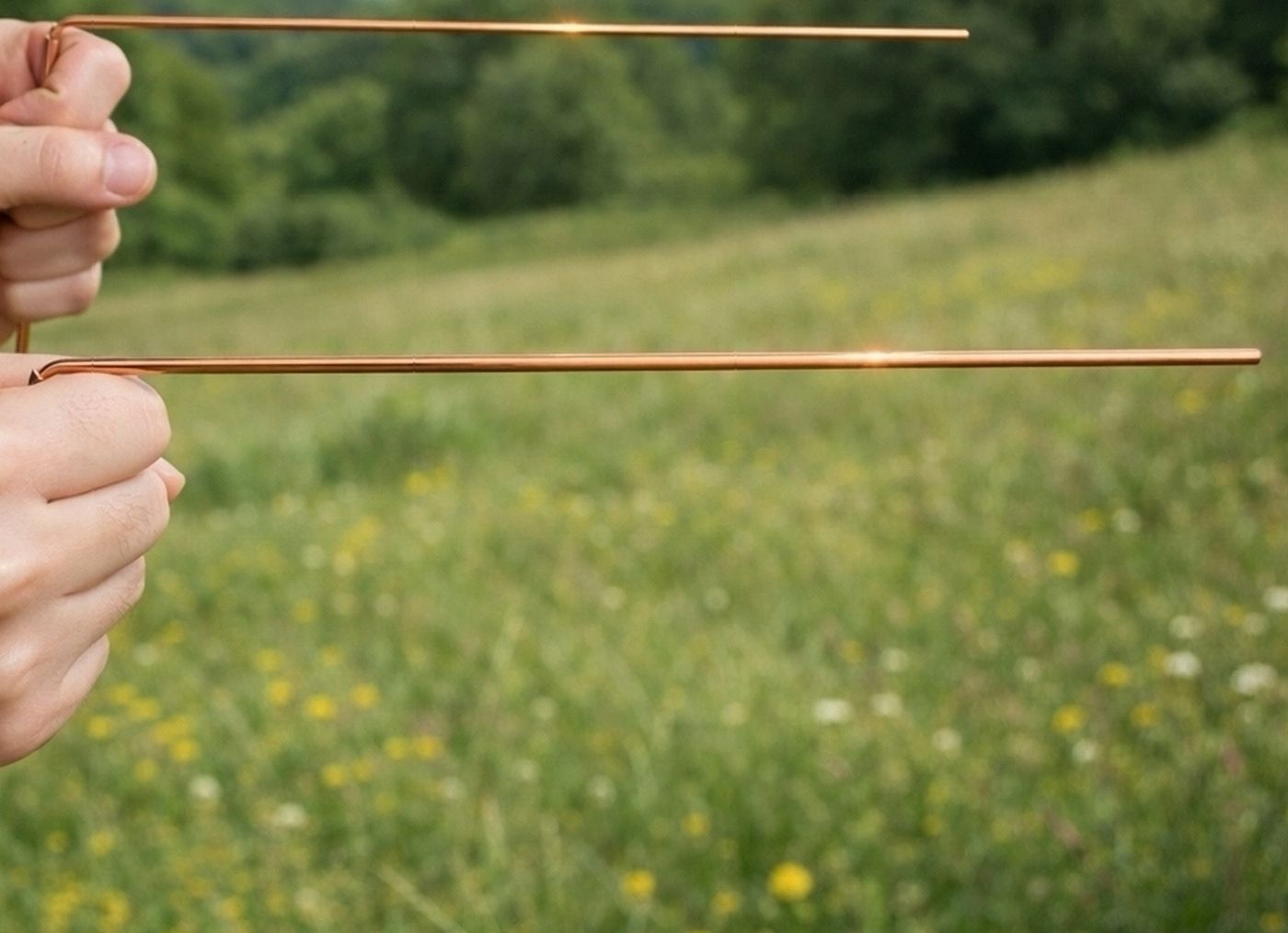
For centuries, people across Europe, the Middle East and parts of Asia have used simple handheld rods to search for things hidden from ordinary view. Water diviners sought underground springs, miners hunted for veins of metal, and others turned to dowsing for reflection, ritual or quiet exploration. What unites all of them is the same simple tool — and the same sense of curiosity.
Dowsing or divining — what's the difference?
In short, there isn't one. The two words describe exactly the same practice and are used interchangeably. "Divining" tends to be the older, more traditional term (and is still the usual word in water divining), while "dowsing" became the common everyday word, especially in Britain and North America. You'll also hear regional names such as water witching or water finding in the United States, and doodlebugging among those who once searched for oil. They all mean the same thing.
The words themselves have curious histories. "Divining" comes from the Latin virgula divina, meaning "divine rod" — language used by the Romans. "Dowsing" is harder to trace: most dictionaries record it as a south-west England dialect word that first appears in print in the late seventeenth century, of genuinely uncertain origin. One popular account holds that German miners brought the practice to Devon and Cornwall in Elizabethan times; another links it to old Cornish words. The honest position, shared by dictionaries and dowsing societies alike, is that the precise root is unknown — which rather suits a practice that has always lived a little outside the mainstream.
The tool itself
A divining rod is usually a lightweight metal rod bent into an L-shape. The short section forms the handle; the longer section extends forward and is left free to rotate. Most modern sets are used as a pair, held loosely and parallel to the ground. As you walk or pause, the rods may swing inward, outward or cross over one another.
Typical sizes. There is no single standard, but most modern L-shaped rods follow a familiar pattern: a long arm of roughly 30 to 40 cm (about 12 to 16 inches) and a short handle section of around 10 to 15 cm (4 to 6 inches). Some users prefer longer arms for a slower, more visible swing; others like shorter, more responsive rods. Traditional Y-shaped rods, cut from a forked branch of hazel or willow, are typically held with two ends in the hands and the single point facing forward, and tend to be larger again. The pair format remains the most popular for beginners because it is simple to hold and easy to read.
A few facts worth knowing
Dowsing is far from a fringe curiosity. The American Society of Dowsers, founded in Vermont in 1961, describes itself as the largest organised body of dowsers in the world, with around 2,000 members drawn from across the United States and beyond. The practice has a genuinely long pedigree: the Greek historian Herodotus is sometimes cited in connection with early forked-rod water finding, and in 1556 the German mineralogist Georgius Agricola documented miners using divining rods to search for ore in his landmark work De Re Metallica. In the modern era, dowsing has even been the subject of large-scale study — a well-known German research programme in the 1980s tested several hundred self-described dowsers. Whatever one concludes from such studies, the sheer breadth of interest across centuries and continents speaks to dowsing's enduring appeal.
How people interpret rod movement
People interpret the movement of rods in different ways:
- Some believe the rods respond to underground water, minerals or subtle environmental energy.
- Others believe the movement comes from unconscious muscular responses linked to human perception and expectation.
- Many sit comfortably between the two, suggesting the mind notices patterns or environmental clues a moment before we consciously register them.
Whichever view you take, the experience itself is what keeps people coming back. Holding a pair of rods asks you to slow down, relax your grip and pay attention — and that alone can make a familiar landscape feel surprisingly alive.
The range of modern uses
Today the uses are broader than ever. Beyond the traditional search for water and minerals, divining rods have become a familiar part of paranormal investigation — ghost and spirit hunting — as well as energy work, meditation and simple yes/no reflection. We look at the paranormal use and the art of reading yes/no answers in their own sections in this series.
A few words on getting started
Most newcomers begin in a quiet outdoor space such as a garden, park or open field. Hold the rods forward and parallel, keep your shoulders relaxed and your elbows close to your body, and walk slowly and steadily. Stay loose rather than forcing anything — if your grip is too tight, the rods simply cannot turn. Some people like to ask a simple yes/no question before they begin; others prefer to walk and observe. There is no single correct method, and part of the pleasure is finding the approach that suits you.