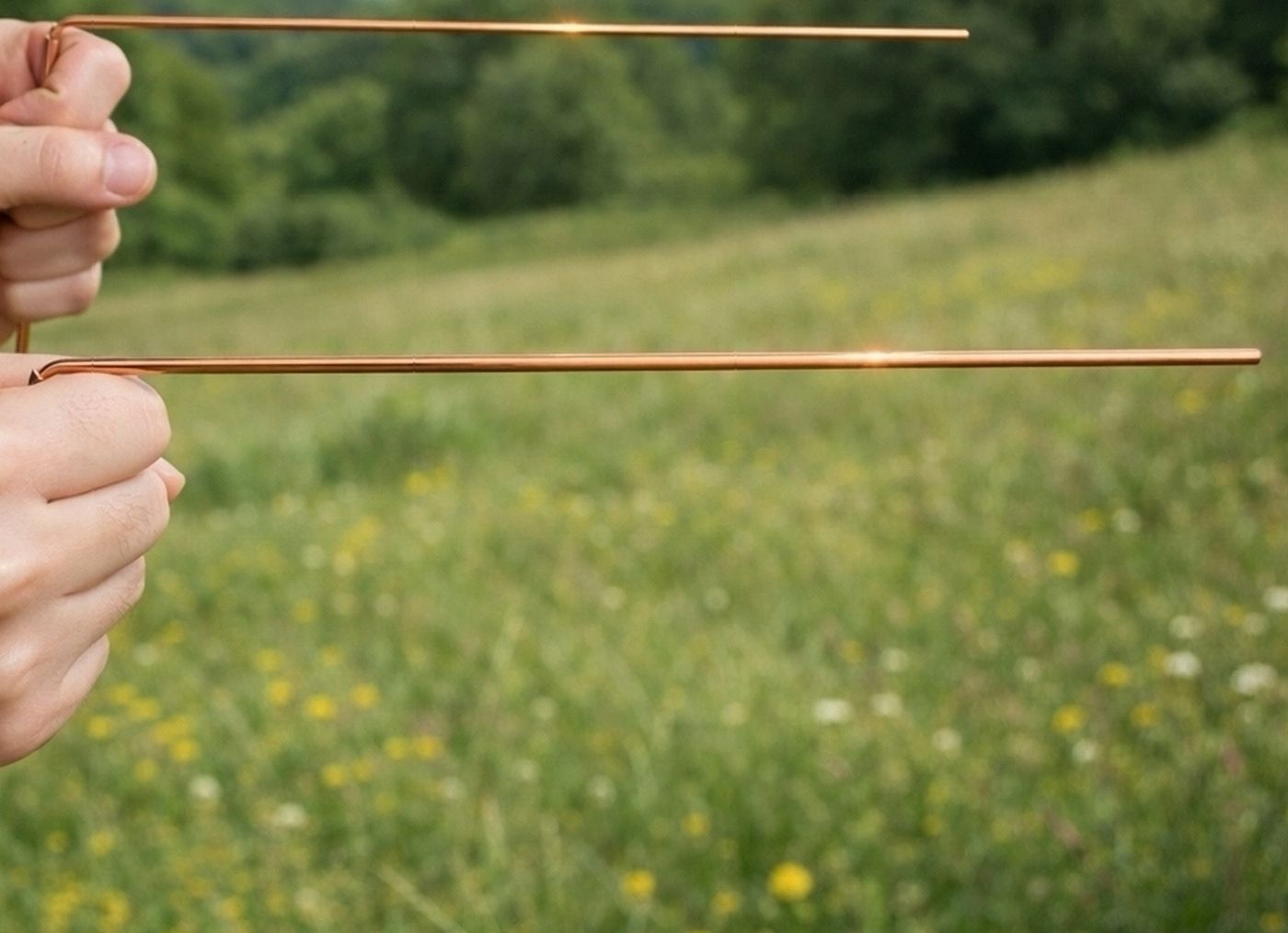
Dowsing occupies an unusual space between folklore, psychology, personal experience and mystery. Rather than pretend that question is settled, it is worth looking honestly at what is understood, what is debated, and what remains genuinely open.
The leading scientific explanation
Most scientists explain rod movement through the ideomotor effect — small, unconscious muscle movements made without deliberate intention. Because the rods rotate so freely, even tiny shifts in grip, wrist or posture can produce a clear and convincing swing. The same principle is used to explain pendulums and Ouija boards. Importantly, these are real, physical movements; they are simply not consciously intended.
The ideomotor effect is well-documented and robust. Experiments consistently show that people who sincerely believe they are not moving an object can be shown, via sensitive measurement, that they are. This is not trickery or self-deception in a dishonest sense — it is the mind and body acting together below the threshold of conscious awareness.
Why we notice what we notice
Humans are exceptional pattern-finders — an ability that helped our ancestors read weather, terrain and seasons. When using rods, people naturally move more slowly and observe more carefully, often picking up on damp ground, changes in vegetation, shifts in temperature or sound. We also remember dramatic moments far more vividly than uneventful ones, so a striking crossing of the rods near a stream tends to stay with us, while the many quiet moments fade. None of this diminishes the experience — but it helps explain why it can feel so compelling.
The theories that reach further
Beyond psychology, enthusiasts and a handful of researchers have proposed mechanisms for a not-yet-understood effect. None is accepted scientific consensus, but several are framed in measured, testable language:
- Weak electromagnetic sensitivity — the idea that flowing water, mineral deposits or buried metal create faint electromagnetic disturbances that conductive rods might respond to. In practice, the fields involved are extremely weak and controlled tests rarely show reliable detection.
- Human magnetoreception — some animals sense the Earth's magnetic field, and there is limited laboratory evidence that the human brain responds weakly to magnetic changes. Whether this connects to dowsing in any reliable way remains unproven.
- Resonance and frequency ideas — the suggestion that materials "resonate" with the rods. This borrows the language of real physics, but no verified model shows handheld rods selectively responding to underground targets.
- Earth energy lines — ley lines, Hartmann and Curry grids. Widely discussed among dowsers, but not demonstrated in mainstream geophysics.
An honest middle ground
History does contain cases where biology detected something before science could explain the mechanism — magnetoreception in birds, electroreception in sharks, infrared sensing in snakes. That does not prove dowsing works, but it is one reason thoughtful people stay open-minded.
Perhaps the fairest summary is this: some users believe divining rods respond to subtle environmental forces or human sensitivities not yet fully understood by science, though no consistent physical mechanism has yet been verified. Whichever way you lean, the practice rewards curiosity.
What is certain is that people across many centuries, cultures and levels of education have found the practice meaningful. That fact alone is interesting, whatever we conclude about the rods themselves.