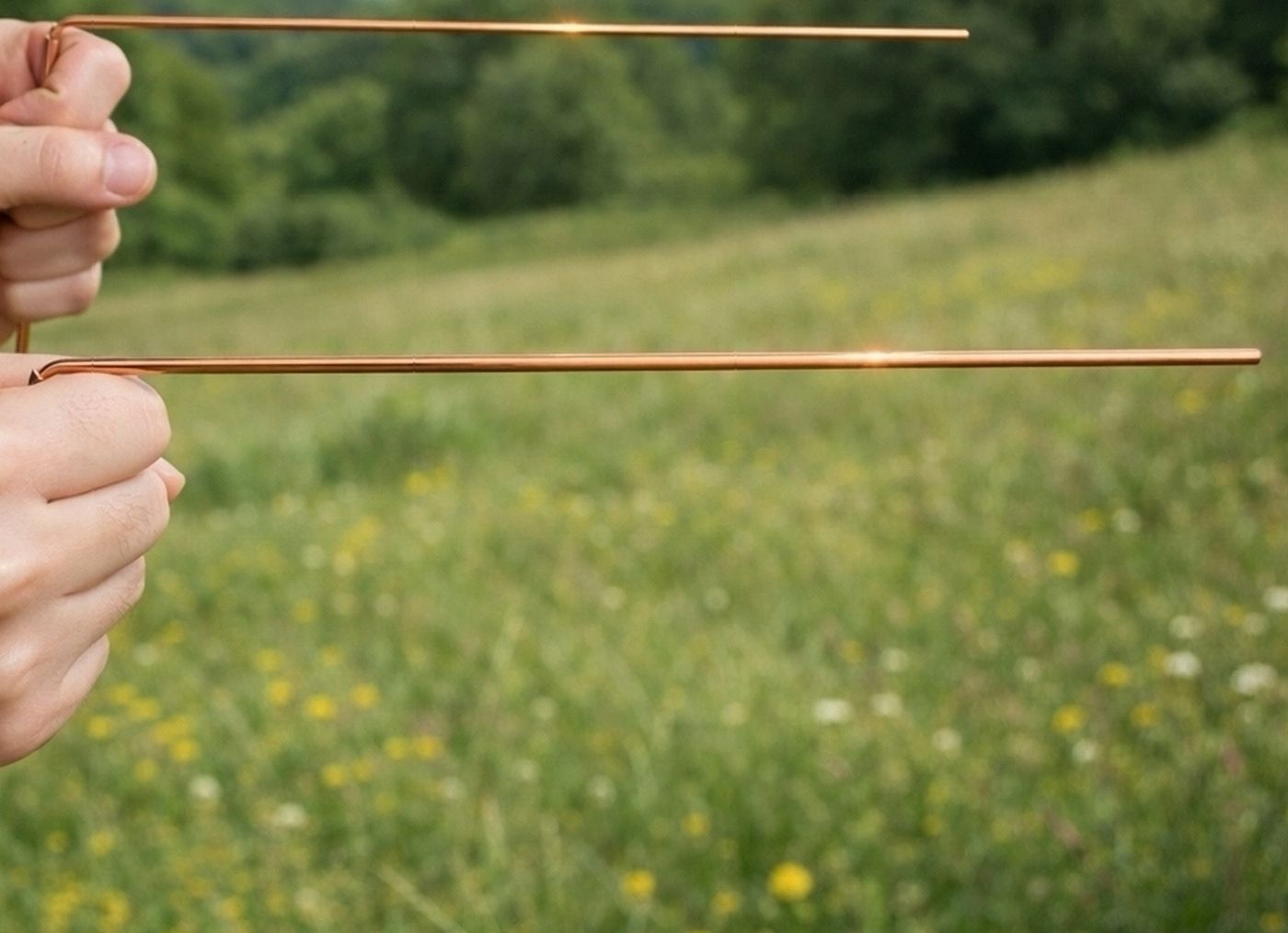
Owning a good pair of rods is the beginning, not the end. This section covers how to practise, how to record what you find, and how to keep your rods in fine condition for years.
Finding your technique
Begin somewhere quiet and open. Hold the rods loosely, parallel to the ground, shoulders relaxed and elbows in. Walk slowly, observe, and repeat the same route several times rather than chasing a single dramatic result. Tension is the enemy of free movement — a relaxed grip lets the rods do what they do.
Keeping a dowsing journal
One of the most overlooked aspects of dowsing is record-keeping. Memory is unreliable and selective; a written record lets genuine patterns surface and lets coincidences reveal themselves for what they are. You needn't make it complicated. Most useful entries note:
- Date and time
- Location
- Weather and ground conditions
- Type of rods used
- Any question asked, in its exact wording
- The rod movement observed
- Your own mood and focus (tired, calm, distracted, relaxed)
- Anything notable in the environment
Over weeks and months this turns a string of isolated moments into something you can actually reason about. For believers, a consistent record can strengthen confidence; for sceptics, it can expose the influence of wind, posture or expectation. Either way, the practice becomes more thoughtful.
A worked example for advanced users
Once you have a number of entries, it helps to plot them rather than read them as a list. The chart below is an illustrative example using invented sample data — it shows one simple way to lay out observations so that a conclusion might be drawn. Here, a practitioner has logged many sessions at the same location and, for each one, recorded two things they could measure independently of the rods: the time of day and the air pressure (low, average or high). Each cell shows how often strong, clear findings occurred under those conditions — a simple heat map of where the interesting results cluster.
| Dawn | Morning | Midday | Afternoon | Evening | |
|---|---|---|---|---|---|
| High pressure | 1findings | 2findings | 1findings | 3findings | 9findings |
| Average pressure | 3findings | 2findings | 0findings | 1findings | 3findings |
| Low pressure | 8findings | 10findings | 2findings | 1findings | 2findings |
Reading the example. In this made-up dataset, two clear hot spots emerge: strong findings cluster around low pressure at dawn and morning, and again around high pressure in the evening. The quiet midday and afternoon cells, by contrast, show very little. The value of plotting it this way is that it turns a vague impression into a genuine, testable pattern. A thoughtful practitioner would now ask why: do those conditions really matter, or do they simply line up with when the location is calmest and quietest, or when the practitioner is most relaxed and focused? The honest next step is to test it deliberately — return at midday under low pressure, or in the evening under low pressure, and see whether the pattern holds or breaks. A good record doesn't hand you the answer; it shows you exactly which question to ask next.
Safety and good practice
Rods are simple but not toys. Avoid running while holding them, never point them toward faces or eyes, take care near roads or hazards, and keep them away from unsupervised children. Outdoors, stay aware of uneven ground and never enter private property without permission.
Cleaning and storage
Copper naturally develops a patina over time — some owners treasure that aged look, others prefer to keep their rods bright. To clean, use a soft cloth, avoid harsh abrasives, and keep the rods dry after use. A protective pouch or wallet prevents scratches and bending, and storage in a dry place preserves both the finish and the smooth, free rotation that makes a rod a pleasure to use. With basic care, a well-made set will last for many years.