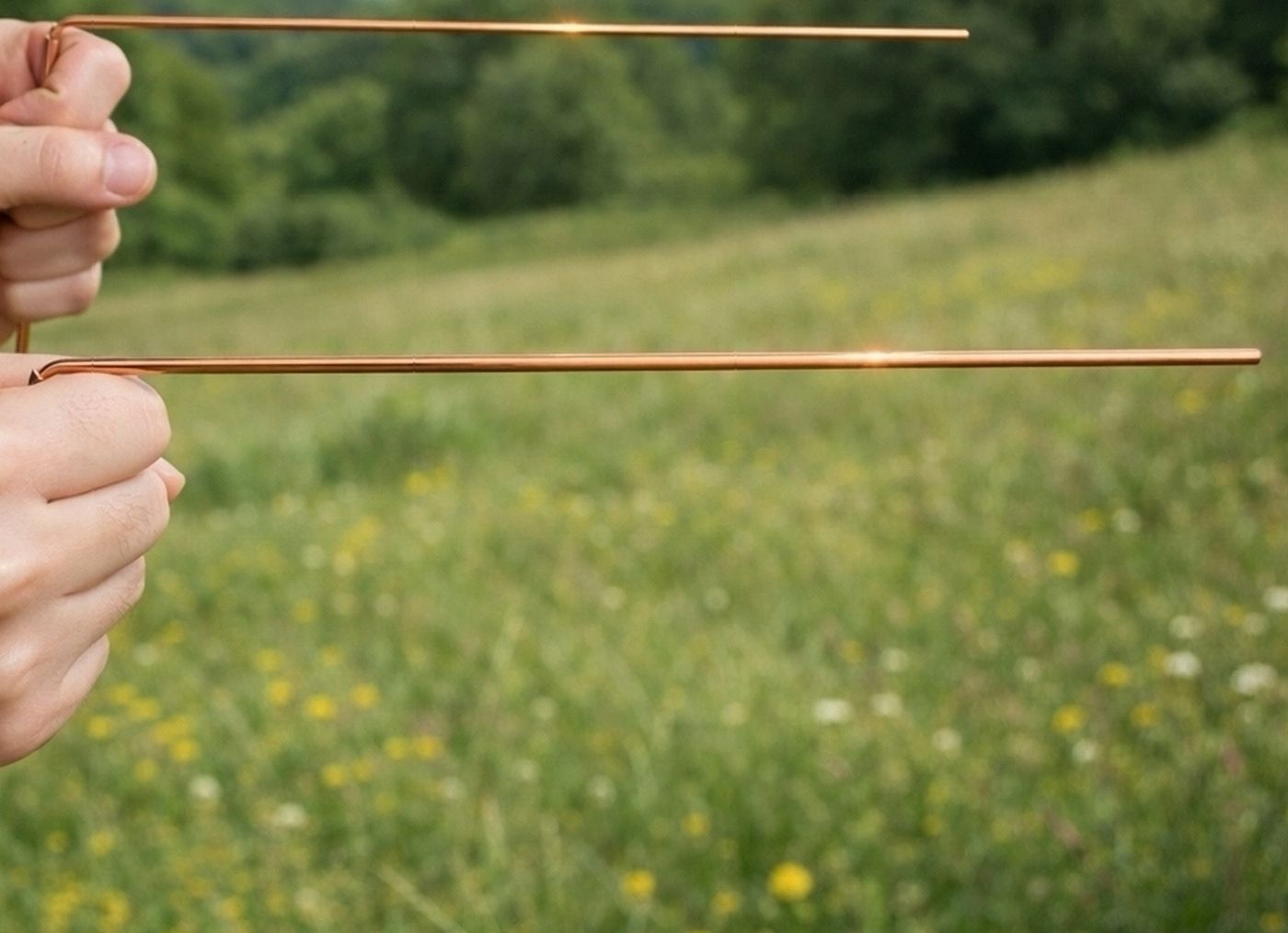
The true origins of dowsing are difficult to pin down. Simple tools made from wood or metal rarely survive the centuries, so much of the early record is fragmentary. Even so, references to divining practices appear across many ancient cultures — from early Chinese traditions of reading the landscape, to depictions of ritual staffs in ancient Egypt, to the deep well of European folklore surrounding hidden springs and underground forces.
The search for water
Perhaps the best-known traditional use was locating underground water. Long before modern surveying existed, rural communities relied on experience, observation and local knowledge when deciding where to dig a well. In many regions the water diviner became a respected figure, walking the fields with rods or a forked branch, watching for the movement that might signal groundwater below. Supporters pointed to successful wells as proof; sceptics countered that seasoned country workers already read terrain, vegetation and moisture extremely well. That debate has never fully settled.
Mining and metals
By the Middle Ages, dowsing was strongly associated with the mining regions of Germany and Central Europe, where it was used in the search for ore — copper, tin, iron, silver and gold. Records and illustrations from the 15th and 16th centuries show miners surveying hillsides with forked rods. Trust in skilled dowsers was genuine, though scepticism existed alongside it, with some scholars and religious authorities dismissing the practice as superstition.
The German mineralogist Georgius Agricola gave a particularly clear account in his 1556 work De Re Metallica — one of the most significant technical manuals of the age — describing in careful detail the use of forked rods by miners searching for ore. It is one of the earliest systematic written records of the practice and confirms that dowsing was taken seriously in professional mining circles long before it became associated purely with folklore.
The rise of scientific scrutiny
As scientific thinking matured through the Enlightenment and beyond, dowsing came under closer examination. Controlled tests tended to produce inconsistent results, and by the 19th and 20th centuries many researchers favoured a psychological explanation — that small, unconscious muscle movements were guiding the rods. Yet dowsing never disappeared. Instead, it adapted.
The practice continued to be used practically, particularly in rural communities where professional geologists were expensive and unreliable. During both World Wars, stories circulated of soldiers using improvised rods in the field. Whether these accounts are reliable is difficult to verify, but they speak to the persistent intuition — across very different people and contexts — that the practice offers something.
A modern practice
Today, many people use divining rods for purposes far removed from wells and mineshafts. Some bring them into meditation or mindfulness; others use them in paranormal investigation, spiritual exploration or simple personal reflection. The enduring image of a lone figure crossing open ground with rods held forward remains instantly recognisable — a reminder that, in a highly technological age, many of us are still drawn to practices that feel tactile, slow and personal.
The history of dowsing is, in the end, the history of a very human impulse: to find things that are hidden, to pay closer attention to the world, and to believe that there may be more to it than immediately meets the eye.